If you missed SIGGRAPH 2017 watch a selection of recorded Live Streaming Sessions.

If you missed SIGGRAPH 2017 watch a selection of recorded Live Streaming Sessions.


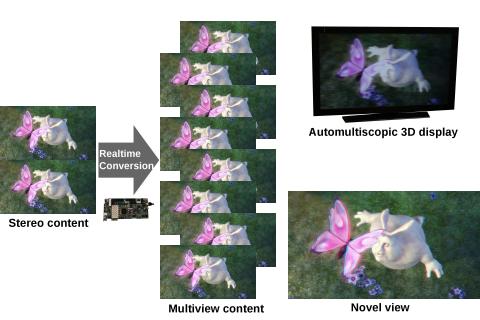
This paper presents a new method for converting stereoscopic content to a multiview version that is suitable for presenting on automultiscopic displays. It also demonstrates hardware implementation capable of performing the conversion on-the-fly. User experiments show that the approach outperforms current real-time solutions.
Petr Kellnhofer
Max-Planck-Institut für Informatik, Massachusetts Institute of Technology
Piotr Didyk
Universität des Saarlandes, Max-Planck-Institut für Informatik
Szu-Po Wang
Massachusetts Institute of Technology
Pitchaya Sitthi-Amorn
Chulalongkorn University
William Freeman
Massachusetts Institute of Technology
Frédo Durand
Massachusetts Institute of Technology
Wojciech Matusik
Massachusetts Institute of Technology
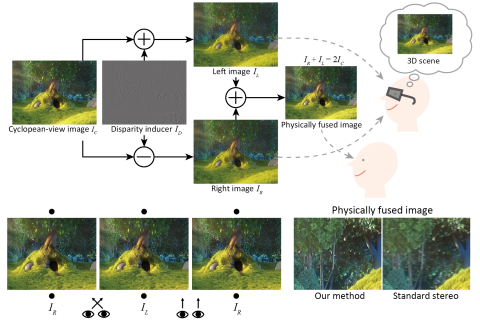
This method generates perfectly ghost-free stereo image pairs for viewers without stereo glasses. The idea is to produce binocular disparity by adding a phase-shifting pattern, and its negative, to an image. Physical fusion of the pair cancels out the disparity components, leaving only the original 2D image visible.
Taiki Fukiage
NTT Communication Science Laboratories
Takahiro Kawabe
NTT Communication Science Laboratories
Shin'ya Nishida
NTT Communication Science Laboratories
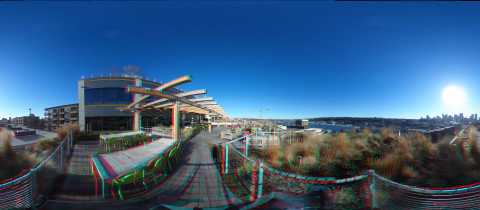
Given two 360º panoramas captured from consumer-grade cameras, this method can stitch an omni-directional stereo panorama by warping the input imagery according to estimated scene geometry.
Kevin Matzen
Facebook, Inc.
Michael Cohen
Facebook, Inc.
Bryce Evans
Facebook, Inc.
Johannes Kopf
Facebook, Inc.
Richard Szeliski
Facebook, Inc.
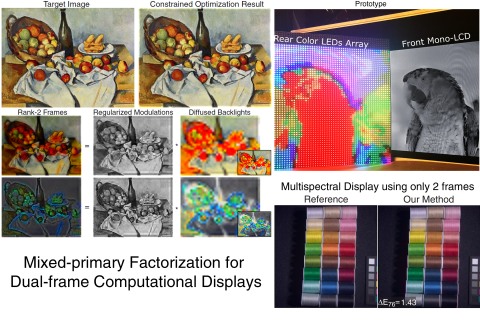
Increasing the resolution and dynamic range of color displays is challenging. Designs are confined by cost and power, and the process requires trade-offs between spatial and temporal resolution for color reproduction. This paper explores hardware-algorithm design to balance such trade-offs by introducing content-adaptive and compressive factorizations to reproduce colors.
Fu-Chung Huang
NVIDIA Corporation
Dawid Pająk
Light
Jonghyun Kim
NVIDIA Corporation
Jan Kautz
NVIDIA Corporation
David Luebke
NVIDIA Corporation


