If you missed SIGGRAPH 2017 watch a selection of recorded Live Streaming Sessions.

If you missed SIGGRAPH 2017 watch a selection of recorded Live Streaming Sessions.


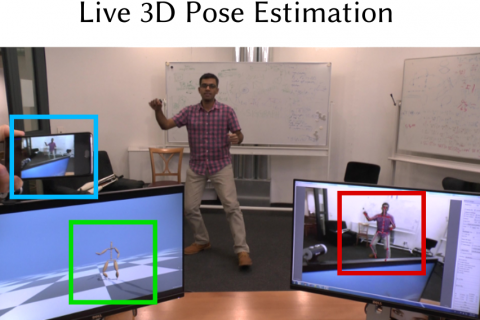
This real-time, CNN-based method for full global 3D human-body pose estimation from a single RGB camera leverages a novel fully convolutional pose formulation in conjunction with a kinematic skeleton-fitting method to yield temporally consistent 3D-pose reconstructions comparable in quality to RGB-D approaches.
Dushyant Mehta
Max Planck Institut für Informatik, Universität des Saarlandes
Srinath Sridhar
Max Planck Institut für Informatik
Oleksandr Sotnychenko
Max Planck Institut für Informatik
Helge Rhodin
Max Planck Institut für Informatik
Mohammad Shafiei
Universität des Saarlandes, Max Planck Institut für Informatik
Hans-Peter Seidel
Max Planck Institut für Informatik
Weipeng Xu
Max Planck Institut für Informatik
Dan Casas
Universidad Rey Juan Carlos
Christian Theobalt
Max Planck Institut für Informatik, Max Planck Center for Visual Computing and Communication
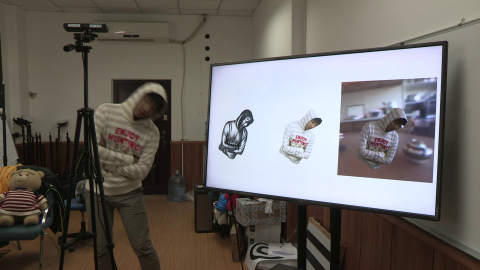
A real-time system that can simultaneously reconstruct a casual scene with a detailed geometry model, surface albedo, per-frame non-rigid motion and environmental lighting using a single RGBD camera.
Kaiwen Guo
Tsinghua University
Feng Xu
Tsinghua University
Tao Yu
Beihang University
Xiaoyang Liu
Tsinghua University
Qionghai Dai
Tsinghua University
Yebin Liu
Tsinghua University
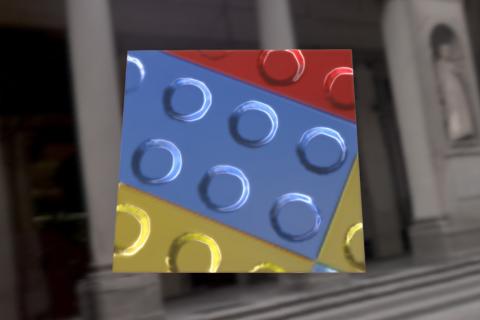
A novel CNN-based method for modeling physically plausible surface appearance from a single photograph of a planar sample under unknown and uncontrolled natural lighting. To reduce the required size of the labeled training dataset, a novel augmented CNN training strategy leverages unlabeled data during training.
Xiao Li
Microsoft Research Asia, University of Science and Technology of China
Yue Dong
Microsoft Research Asia
Pieter Peers
College of William & Mary
Xin Tong
Microsoft Research
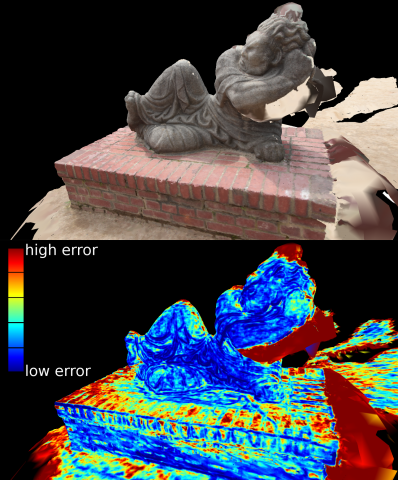
This paper evaluates end-to-end image-based modeling and rendering systems by analyzing how well they predict secret test images. The technique can be used, for example, to locally highlight 3D reconstruction errors.
Michael Waechter
Technische Universität Darmstadt
Mate Beljian
Technische Universität Darmstadt
Simon Fuhrmann
Technische Universität Darmstadt
Nils Moehrle
Technische Universität Darmstadt
Johannes Kopf
Facebook, Inc.
Michael Goesele
Technische Universität Darmstadt
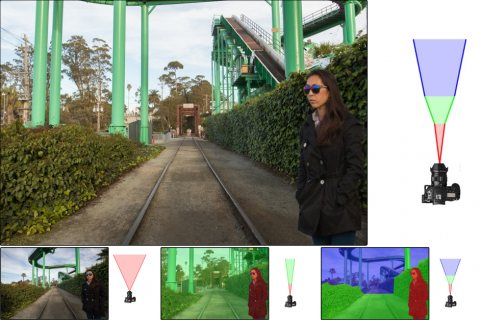
Introducing computational zoom, a framework that allows a photographer to manipulate several aspects of composition in post-processing from a stack of pictures captured at different distances from the scene. Using this framework, the photographer can change the relative magnification and perspective of objects at different depths in post-processing.
Abhishek Badki
University of California, Santa Barbara
Orazio Gallo
NVIDIA Research
Jan Kautz
NVIDIA Research
Pradeep Sen
University of California, Santa Barbara


